Next-Level Procurement™
Rethink → Reshape → Get Ahead™
Value is not lost because of missing tools.
It's lost because procurement lacks influence.
Procurement says it wants earlier involvement.
The harder question is why stakeholders aren't asking for it.
Being invited early is not the same as having influence.
Procurement can be in the room and still enter after the real choices have been shaped. Influence depends on what happens while options, priorities and trade-offs are still open.
Stakeholders rarely tell Procurement when its influence is disappearing. They simply stop involving it.
The five dimensions of influence
Influence is not one thing
Next-Level Procurement looks at five conditions that can shape whether Procurement can influence business decisions before value is committed.
Behaviour, not maturity theatre.
Business experience, not Procurement intention.
Evidence before conclusions.
The Free Diagnostic starts with your own view.
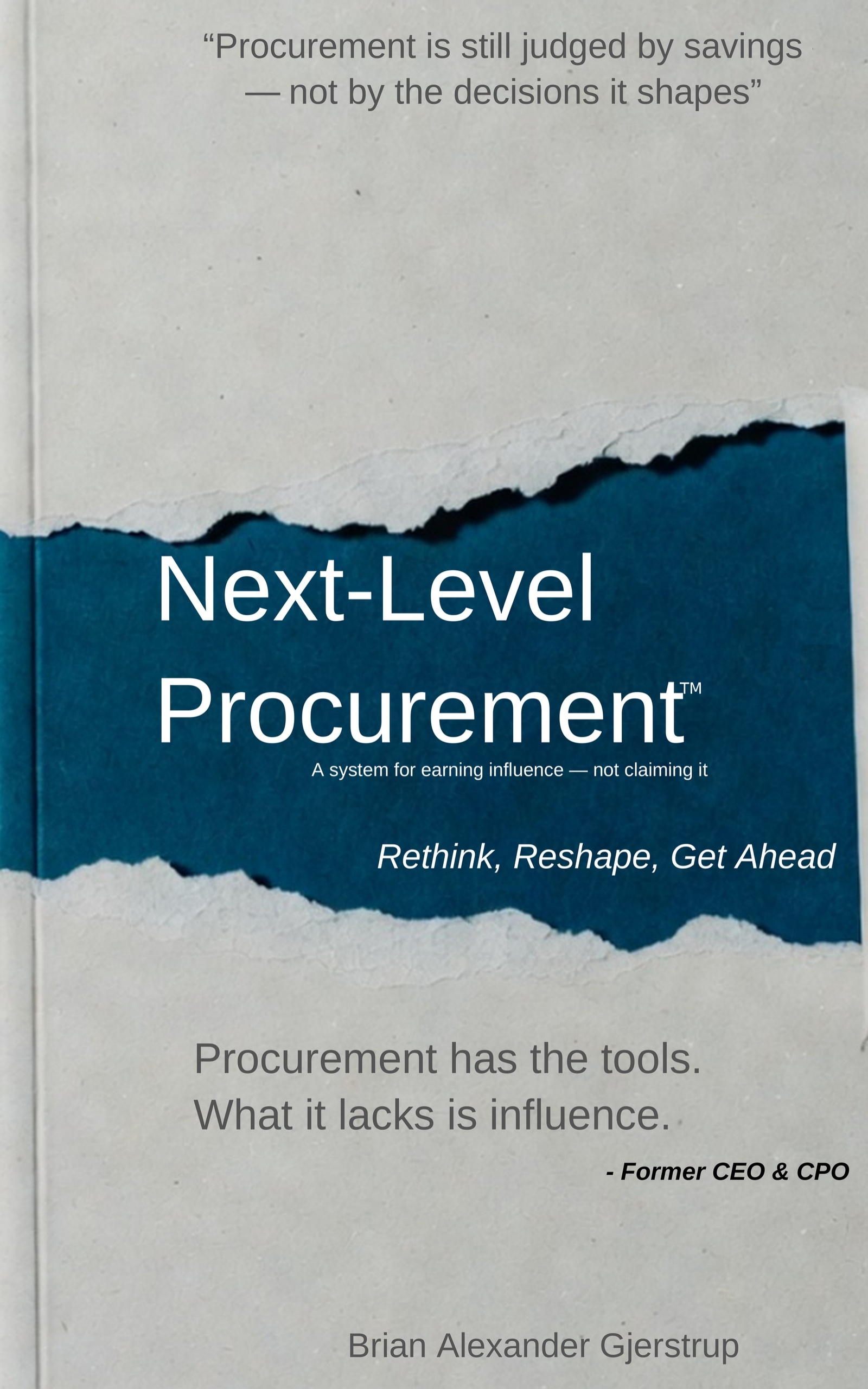
The Book
The thinking behind Next-Level Procurement™
The book explains why procurement is still often judged by savings, compliance, and activity — even when it wants to be seen as strategic.
It explores how influence is built or lost in everyday stakeholder interactions and introduces the models, frameworks, and micro-moments behind Next-Level Procurement™.
Publication date: 15 October 2026
Recognise where everyday interactions build or erode Procurement’s influence — and what needs to change for its judgement to shape decisions that matter.
Why this matters
Procurement is still seen for what it does — not why it exists.
Savings. Compliance. Process.
That is how procurement is often measured.
But real value is shaped elsewhere:
in decisions, timing, trade-offs, trust, and the way business problems are solved.
That only happens when procurement has influence.
And influence is earned — not assumed.
The Pattern
Procurement believes it is strategic. Stakeholders often experience something else.
Across industries, a similar pattern can emerge.
Procurement believes it contributes strategically.
Stakeholders often experience procurement as late, reactive, or process-led.
Global manufacturer
Procurement believed
They were involved early in decisions.
Stakeholders experienced
Late, reactive input when options were already limited.
Financial services firm
Procurement believed
They added strategic value.
Stakeholders experienced
Process enforcement instead of business impact.
Technology company
Procurement believed
They were trusted advisors.
Stakeholders experienced
A function they could bypass when speed mattered.
This gap is not created by tools
It is created in everyday moments — how procurement shows up, asks questions, frames decisions, handles friction, and earns trust.
When stakeholders do not experience procurement's value, they stop involving it.
Not out of disrespect.
Because they do not see the difference it makes.
Procurement is not ignored because of capability.
It is ignored because of how it is experienced.
From function to force
Most procurement teams are seen as a function.
The few that matter are seen as problem solvers.
The difference is not more tools.
It is influence — earned in everyday interactions.
Next-Level Procurement™ helps leaders understand how that influence is earned — and where to act.
Procurement influence is often limited because procurement is involved too late, seen as a cost function, or not recognized as a value creator. The Next-Level Procurement™ book and the Free Diagnostic help procurement leaders understand and strengthen procurement's influence.
As AI makes intelligence more abundant, human trust becomes more valuable.
Tools, data and analysis will become easier to access. Being trusted early enough to shape a decision will not.
Procurement influence is earned — not assumed.
It starts with understanding how procurement is actually experienced inside your organization.
If you cannot see influence, you cannot manage it.